Free · Android · No account

Catch every meow.
Learn what she means.

Your cat invented her language for you. Meow Catch listens, catches every call, and helps you work out what each one means — while helping build an open database of cat speech.

Meow Catch: a ginger cat mid-meow with sound waves

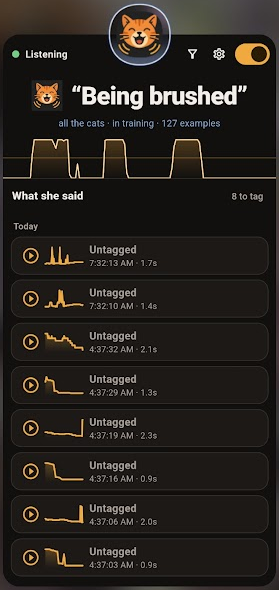
This is it running

Not a mockup. One screen, because everything happens on one screen.

She meowed. It caught the call, measured it, compared it against the tagged examples it has, and put its best reading at the top — with the evidence attached. Then it went back to listening.

  • The answer, and where it came from “Being brushed” — and directly under it, all the cats · in training · 127 examples. You always know how much is standing behind a reading, so you can decide what it's worth.
  • The call, drawn The live trace across the middle. Each catch keeps its own shape, so you learn to recognise her calls by sight.
  • Everything she said today A running list, newest first, each with its shape, the time and how long it lasted. Tap any one to play it back or tell it what she meant — not just the last one.
  • Still listening Top left, green. It keeps catching while you tag, and while the screen is off.
Meow Catch listening: the reading "Being brushed" with 127 examples behind it, a live pitch trace, and today's catches listed below waiting to be tagged.

The honest part, first

Because you should know exactly what this is before you install it.

Cats barely meow at each other. Adult cats went almost silent with their own kind — meowing is something they invented for us, and each cat largely works out her own vocabulary with her own person.

So there is no universal cat dictionary to hand you, and anyone selling you one is guessing. What there is: real, shared patterns in urgency and distress and contentment, and a private language between you and her that only the two of you know.

Meow Catch learns both. The shared part comes from everyone. The private part comes from you — and it stays yours.

How it works

Turn it on and put the phone down. It does the rest.

  1. It learns your room first. Every kitchen and every phone mic is a different instrument. Meow Catch measures your room's noise so a quiet meow next to a running dishwasher still counts.
  2. It listens, even with the screen off. Cats don't wait until you're holding the phone. A notification stays up the entire time it's listening, so you always know.
  3. It catches the meow — and holds the last 30 seconds. Missed one? Tap "I heard that" and it reaches back and grabs it. You never lose a meow for being three seconds slow.
  4. You tell it what she meant. Two taps for the quick ones, or write as much as you want: where she was, what was happening, the sounds you actually hear. Mark the ones you're certain about.
  5. Every cat teaches the next one. The certain ones carry the weight. The rest still help find the shapes nobody has named yet.

What you get on day one

Long before any of the clever stuff exists.

A record of her talking

Every meow, catalogued by day and time, with how long it was and how high. A diary of your cat you didn't know you could keep.

The shape of every call

See the pitch rise and fall. Rising is usually a demand. Flat is usually hello. Falling is usually a complaint. You'll start recognising them.

Her own vocabulary

Your tags are yours. Over time you're not guessing — you're reading a list of the things she actually says, in the words you gave them.

It works offline

Everything is caught, stored and readable on your phone. No account, no signup, nothing required to use it.

It listens with the screen off

Put the phone down and go about your day. Capture keeps running in the background, and a notification stays up the whole time so you always know it is on.

It learns your cat, not cats

Matches happen against the calls you tagged, so it gets better at your cat specifically. The more you tell it, the more it recognises her rather than cats in general.

Where it stands

It works today. It has barely started. Both are true, and we would rather say so than pick one.

Now · in training

It already answers

Meow Catch catches, catalogues and reads. It starts from 440 real cat recordings out of published research, so it has something to compare against the day you install it, and it matches new calls against your own tagged ones as well. The answers are real. They are also early, and it says so every single time rather than dressing a guess up as a fact.

Next · it has only just started

It needs thousands more

Four hundred and forty recordings is a start, not a language. Getting from “early and often wrong” to something you would actually rely on takes thousands of meows from thousands of cats, each one tagged by the person who knows her. That is the whole job, and it is why the app asks you to tag rather than just listen. The “in training” label comes off the day the numbers earn it, and not one day before.

What leaves your phone

An app that listens in your home owes you a straight answer on this.

Numbers, not audio

No sound ever leaves your phone — not the room, not even the meow. What goes up is the measurement of the call: the shape of its pitch, its tone fingerprint, how long it was, and how loud your room was at the time. There is nothing in it anyone could listen to.

Your notes, if you write them

What you tagged travels with the measurements, because that's the part that teaches it. If you don't tag it, nothing about you goes with it.

No account, no identity

There's nothing to sign up for. We don't want your email and we didn't build anywhere to put it.

You keep everything

Uploading is a copy, never a move. Every clip stays on your phone as a normal audio file you can play, share or delete.

Nothing happens until you say so

The microphone is only touched while listening is switched on. Turn it off and the app is inert — no background listening, no exceptions.

Wrong catch? Bin it

Swipe away anything that was not your cat, or clear the whole catalog in one go. Deleting on your phone is yours to do at any time, for any reason.

What's actually in a meow

A meow is not one sound. It is at least five things happening at once, and most tools draw only the first.

The harmonic stack

Not one pitch — a fundamental plus overtones stacked above it. Which overtones are loud is the timbre. A single line draws one number and throws the stack away.

Formants — the big one

A meow is a diphthong. Literally “m-ee-ah-ooo” — the mouth changes shape mid-call and the resonances slide. That formant trajectory is why it sounds like a word instead of a tone, and it may be the most meaning-carrying thing in the whole signal.

Nonlinear phenomena

Cats do subharmonics, biphonation — two independent pitches at once — and outright chaos. That is what makes a yowl sound rough and urgent rather than smooth and polite. Documented bioacoustics, not a metaphor, and it shows up as visible structure.

Amplitude modulation

The flutter in a trill or a chirrup, twenty to forty times a second. Invisible at ordinary resolution.

Onset and decay

How the call is attacked and how it is released. The shape of the beginning and the end carries as much as the middle.

Why it matters here

Every one of these is a place meaning could be hiding. The more of the call we can actually see and measure, the better the chance of working out what she is telling you.

Understanding goes both ways

Listening is only half of it. If you want to be understood back, our sister site has free, practical cat training guides — and dog training if there is one of those in the house too.

Get it

Android, free, no strings. Install from the file — your phone will ask you to allow it, because it isn't from the Play Store.

Needs Android 6 or newer and a microphone.

Works best left running while you're home — the more of her ordinary day it hears, the better your catalogue gets.